Public Affairs is Changing: Here’s What Practitioners Need to Know

Sharon Copeland is Vice President at The Herald Group, where she’s worked on public affairs campaigns across all industries for the past eight years—specializing in digital strategy and audience engagement. The following is adapted from her remarks at a recent public affairs panel at the 2026 Pollies, a political consulting conference.
There’s overlap between public affairs and election-focused practitioners—but the distinction matters.
Campaigns are speaking to 260 million voters. Public affairs is focused on influencing a much smaller, more consequential group: policymakers, regulators, and the constituencies that move them. The outcomes are measured entirely differently as well.
The public affairs landscape in 2026 looks nothing like it did two cycles ago. A volatile midterm environment is reshaping who matters and when, state-level policy fights are moving faster than most organizations can keep up with, and a fragmented media landscape is raising the bar on what a real digital advocacy strategy actually requires.
Here's what practitioners need to understand and adapt—right now.
The Midterm Environment Is Reshaping Advocacy
With mid-decade redistricting and a “referendum” environment around major policy issues, the ground is shifting in real time. Control, committee power, and political incentives are all in play.
That changes the approach:
Stakeholder mapping can’t be static. You need to know not just who matters now, but who is likely to matter next and plan accordingly. Much of Congress is vulnerable, newly elected, or gaining power, and leadership changes often.
Messaging must reflect political reality. Kitchen table issues are the name of the game as we creep toward the November election. Tie issues to the impacts on individuals and create political opportunities or consequences based on where you’ve mapped the stakeholders and how that ties into voters’ perceptions.
Timing needs to be strategic. Legislative windows, work periods, and election cycles all dictate when advocacy breaks through or gets ignored.
The Shift to States Is a Ripe Arena
Federal gridlock isn’t new. But what’s different now is how much policy action is being driven at the state level — and how quickly you can achieve good policy across multiple states while also beta testing for federal fights.
Organizations that built their strategies around Washington are being forced to rebalance in real time with the following:
Localized intelligence over national assumptions. National polling and broad narratives only get you so far. The issue lives or dies in the local nuances.
State-specific individual validators over national parties and talking heads. Influence at the state level is often more personal and less institutional. It’s more about which individuals or local groups actually carry credibility.
Tactics hit differently at the state level. State and local officials aren't insulated the way federal offices are. The volume and intensity of advocacy they experience is lower, which means the same tactics land harder. A hundred calls or emails can overwhelm a state office in a way that wouldn't be federally. Coordinated paid media or coalition pressure can feel immediate and inescapable. State fights move faster, with fewer guardrails and less predictability.
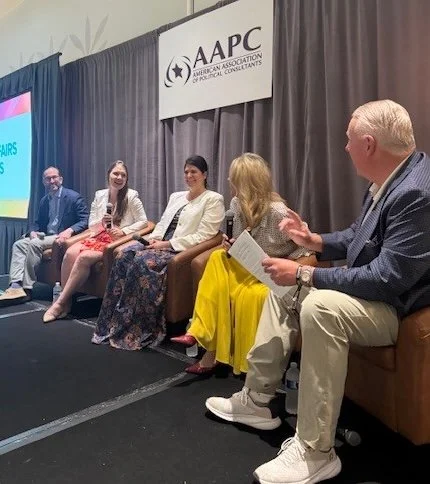
THG Vice President Sharon Copeland speaking at the 2026 Pollies Public Affairs panel.
Media Fragmentation and Getting It Right
Everyone talks about the fragmentation of media and the rise of CTV. While CTV certainly is changing the game and offers precision targeting through a high-impact moment, it’s just another tool at our fingertips. There are so many channels, it often leaves clients asking which one is the best. There’s no one answer.
What’s working now:
Leverage channels strategically. Heightened political attention is creating both more noise and more opportunity. Strategy and surround sound matter more than any single channel. The goal isn’t just reach; it’s reinforcement. Your audience should encounter your message across the environments that shape their day.
Data is the backbone, not an input. Your audience sets need to be inclusive enough that your core audience is going to be delivered the messaging but tight enough that you’re not wasting impressions on people that don’t have an impact on the outcome. Automated data pipelines that continuously refine targeting based on behavior, exposure, and engagement are crucial.
Creative is adaptive, not static. Messaging should evolve based on where someone is in the decision cycle, rather than relying on a single piece of content to do everything.
What’s often missed is that you don’t get partial credit. If you have the right message and messenger but the wrong targeting, it doesn’t matter. If you have perfect data but messaging that doesn’t move people, it doesn’t land. That’s where we’re seeing the biggest gap — between strategy and execution.
Coalition-Building in a Low-Trust Environment
Trust in institutions is low. Only 17% of Americans trust the government to do what’s right. Coalitions built on shared politics are harder to sustain and use effectively. This is what we are seeing play out effectively:
Lead with impact, not ideology. Avoid partisan cues. People come together around kitchen table issues that they can feel.
Build unlikely alliances. The most effective coalitions aren’t the most obvious ones; they’re the ones with aligned incentives.
Local voices carry disproportionate weight. Business leaders, community figures, and in-state validators can have outsized impacts in legislators' back yards.
The right messenger depends on the audience. Economic growth, affordability, wages, or access all resonate differently depending on who’s delivering it.
Build repetition across voices that stakeholders trust to establish credibility, rather than one group speaking the loudest
Increasingly, that’s being informed by smarter inputs: using data and AI to map coalition partners, understand who has influence on which issues, and deploy them with intention.
Conclusion
What’s clear right now is how quickly the environment is changing both politically and technologically.
This isn’t about any one tactic. It’s about integration of strategy, data, messaging, messengers, paid media, and coalitions all working together and evolving in real time.
After more than 20 years in this space, the fundamentals still hold. But how you apply them has to adapt just as quickly as the landscape itself.